Books

The Philippine Economy Towards 2050: Economic Structure and Monetary Reality.
This book provides a rigorous analysis of the factors underlying the Philippines’ relative economic stagnation compared with its Southeast Asian neighbors despite sustained optimistic government rhetoric.
Three critical factors are identified: failure to industrialize and undergo a complete economic transformation, resulting in an underdeveloped agricultural sector and an economy dependent on low-productivity services; ineffective reforms that differ markedly from successful regional models; and self-defeating fiscal conservatism that has prevented adequate investment in essential public goods and industrial policy. Using two innovative economic models—a macro-econometric model and an employment-education forecasting model—the book offers forecasts of the Philippines’ income per capita, poverty, or economic structure, through 2050. The researchers warn that unless the country’s economic policy focuses on the transformation of the economy (with emphasis on the modernization of agriculture and the development of the manufacturing sector) and the government adopts a more active role, the Philippines will experience more of the same (MOTS) during the next decades.
An accessible resource for scholars, students, journalists, officials, and business professionals as an introduction to Philippine history, politics, and economy, the book will also be useful for development practitioners with its insights on structural transformation and on fiscal and monetary policy.
Innovation and Structural Transformation in Asia. 2025. Routledge Focus.
This book explores recent drivers of Asia’s growth and economic development. The analysis is based on a database created by the authors. It covers a large number of economies, including 39 from Asia for the period 1990–2020.
The database and the analysis in the book use novel indicators of development. It is structured along four areas: productivity and structural change, global value chains (GVCs), economic complexity, and the Fourth Industrial Revolution (4IR). The book offers insights into current economic performance and future prospects. It shows great heterogeneity across the region, highlighting a range of development experiences. Each chapter contains an accessible methodological section of the concepts used, explaining the construction of indicators and how they should be interpreted.
The book will interest scholars of Asian economics, structural transformation, productivity, GVCs, complexity, and 4IR studies. The publicly available database will also appeal to policymakers and researchers interested in data analysis.
Development and Modern Industrial Policy in Practice provides an up-to-date analysis of industrial policy. Modern industrial policy refers to the set of actions and strategies used to favor the more dynamic sectors of the economy. A key aspect of modern industrial policy is embedding private initiative in a framework of public action to encourage diversification, upgrading, and technological dynamism to achieve development in the twenty-first century.
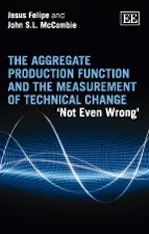
The Aggregate Production Function And The Measurement Of Technical Change: ‘Not Even Wrong’. 2013. Edward Elgar.
This authoritative and stimulating book represents a fundamental critique of the aggregate production function, a concept widely used in macroeconomics. The authors explain why, despite the serious aggregation problems that surround it, aggregate production functions often give plausible statistical results.
Read book reviews:
Journal of the Asia Pacific Economy
Revue de la régulation
Applied Economic Journal
Review of Keynesian Economics
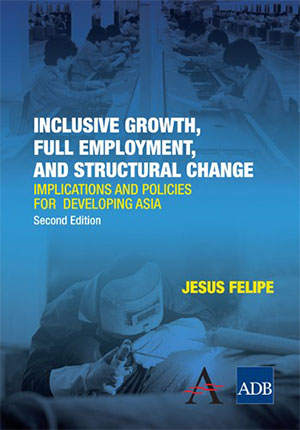
This book argues that structural change (reallocation of resources across sectors and higher diversification and sophistication of production and exports) is the key to sustained and fast growth in developing Asia.
Read book reviews:
Asia-Pacific Economic Literature
Read Amazon.com book review:
First edition
Second edition